
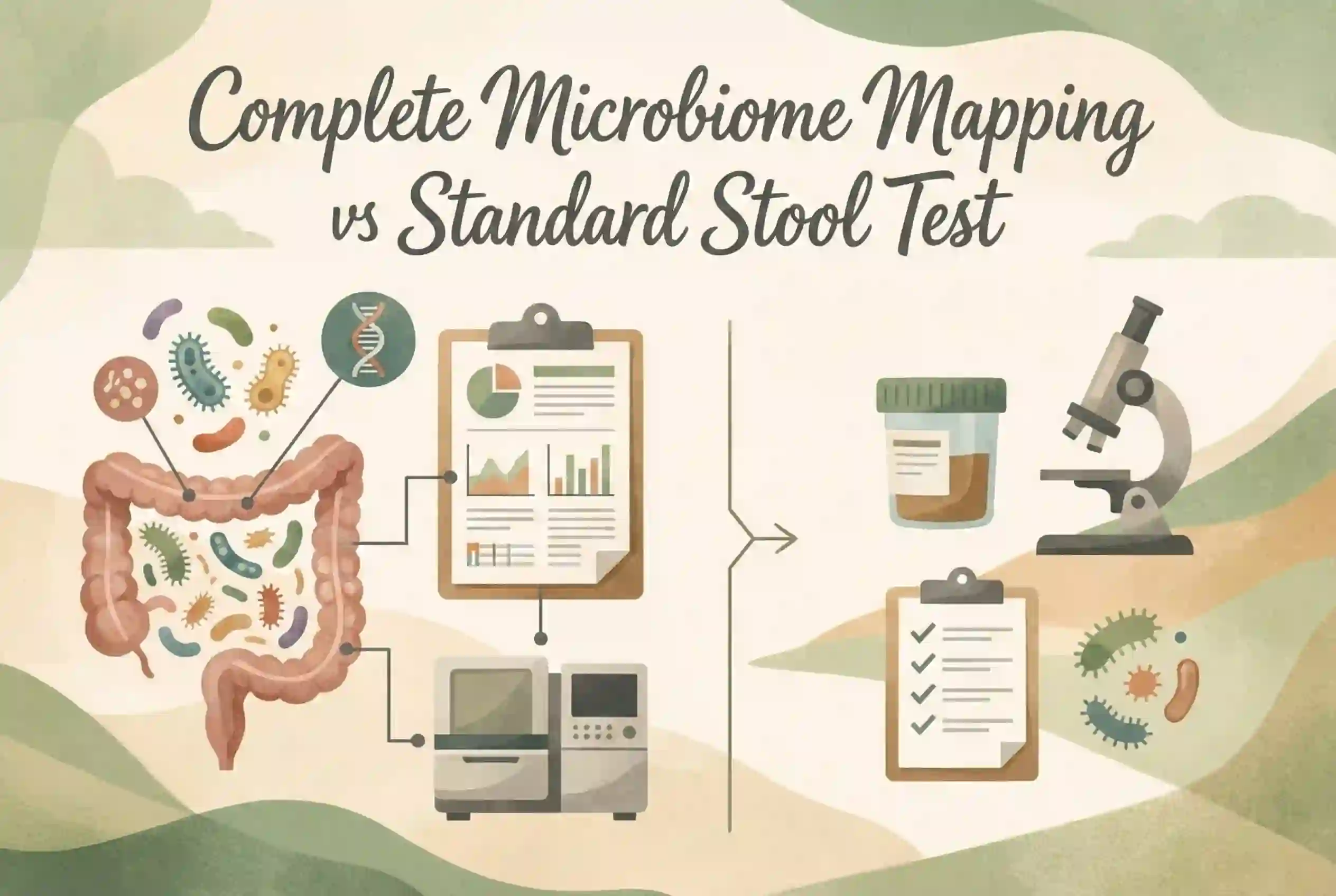
I’ve ordered both types of tests for clients over the years, and the question I hear most often is: “Do I really need the expensive one, or will the basic test do?”
It’s a fair question. You’re looking at potentially spending hundreds of dollars, you want actual answers, and you’re probably already frustrated with your gut symptoms. The last thing you need is confusion about which test to choose.
Here’s what I’ve learned after 12+ years of interpreting both standard stool tests and comprehensive microbiome mapping: sometimes the basic test is plenty, and sometimes it’s not even close to enough. The trick is knowing which situation you’re in.
Let me walk you through what each test actually shows, when I recommend one over the other, and how to make a decision that fits your budget and your symptoms.
What Actually Shows Up on a Standard Stool Test
When your GP orders a standard stool test through a pathology lab, you’re typically looking at:
- Parasites and worms (microscopy)
- Occult blood (hidden blood in stool)
- Basic bacterial culture (looking for known pathogens like Salmonella, Campylobacter, Shigella)
- Sometimes Helicobacter pylori if specifically requested
- Occasionally Clostridium difficile if there’s a clinical reason
That’s essentially it. The test is designed to catch acute infections and obvious problems, not to give you a detailed picture of your gut ecosystem.
When This Is Genuinely Useful
I’ve had clients get clear, actionable results from standard testing. A woman came to me with sudden onset diarrhoea after a holiday in Bali. Standard stool test picked up Blastocystis hominis. We treated it, symptoms resolved. Job done.
Standard testing makes sense when:
- You have acute symptoms (sudden diarrhoea, severe cramping, blood in stool)
- There’s a travel history or suspected food poisoning
- Your doctor wants to rule out parasites before investigating further
- You need a baseline before spending money on comprehensive testing
- Budget is genuinely tight and you need somewhere to start
The Gaps: What It Misses Entirely
Here’s what standard testing won’t tell you:
- Your overall bacterial diversity
- Beneficial bacteria levels (Lactobacillus, Bifidobacterium)
- Inflammatory markers in the gut
- Digestive enzyme function
- Fat absorption or malabsorption markers
- Yeast overgrowth (Candida)
- Opportunistic bacteria that aren’t “pathogens” but cause problems anyway
- Short-chain fatty acid production
- Gut permeability markers
For chronic digestive health issues, these gaps matter.
Cost and Accessibility
Standard stool tests through your GP:
- Bulk billed with Medicare (no out-of-pocket cost)
- Sometimes a small gap fee at certain pathology labs ($20-50)
- Results typically back in 3-7 days
- Covers the basics, nothing more
This is genuinely the most cost-effective starting point if you’re working with limited finances.
What Complete Microbiome Mapping Actually Involves
Comprehensive microbiome testing (sometimes called GI mapping or advanced stool analysis) uses DNA technology to identify and quantify the organisms in your gut.
What These Tests Measure
Different labs vary, but most comprehensive panels include:
Bacterial analysis:
- Beneficial bacteria (multiple strains)
- Commensal bacteria (the neutral players)
- Opportunistic bacteria (can cause issues in excess)
- Pathogenic bacteria
Other organisms:
- Parasites (more sensitive detection than standard tests)
- Yeast and fungi
- Viruses (some panels)
Functional markers:
- Inflammation markers (calprotectin, lactoferrin)
- Immune response markers (secretory IgA)
- Digestive function (elastase for pancreatic function)
- Intestinal health markers
- Short-chain fatty acids
Additional markers (depending on the lab):
- Zonulin (gut permeability)
- Beta-glucuronidase (detoxification enzyme)
- Antibiotic resistance genes
Common Providers in Australia
The main labs I work with include Microba, Invivo, GI-MAP, and a few others. Each has slightly different methodologies and marker selections. I’m not tied to one provider, I choose based on what the client’s symptoms suggest we need to investigate.
The Reality of Sample Collection
Let me be straight with you: it’s a stool sample. You’re collecting it at home, usually needing to avoid certain foods and supplements for a few days beforehand. Most kits provide everything you need, including return postage. It’s not glamorous, but it’s straightforward.
Processing takes 2-4 weeks depending on the lab.
The Cost Reality Check
Let’s talk numbers because this matters.
Comprehensive microbiome mapping in Australia:
- Typically $350-500 for the test itself
- Some advanced panels up to $600-700
- Not covered by Medicare
- Rarely covered by private health (check your extras, but don’t count on it)
- This is just the test, not the consultation to interpret it
For many people, this is a significant expense. I’m not going to pretend otherwise.
When the Investment Makes Sense
If you’ve already spent hundreds (or thousands) on supplements that didn’t work, seen multiple practitioners without progress, or been dealing with gut issues for years, comprehensive testing can actually save you money by giving clear direction.
It makes less sense if you’re only a few weeks into symptoms or haven’t tried basic dietary changes yet.
When I Actually Recommend Microbiome Mapping
I suggest comprehensive testing when:
You’ve tried the basics without success:
- Eliminated common triggers (gluten, dairy, FODMAPs)
- Worked with a practitioner on initial protocols
- Still have persistent symptoms after 3-6 months
Your presentation is complex:
- Multiple systems affected (gut plus skin, mood, fatigue, joint pain)
- Symptoms that don’t fit a clear pattern
- History of antibiotic use or gut infections
You have specific conditions that benefit from detailed data:
- Recurrent SIBO (we need to understand the underlying ecosystem – more on SIBO treatment here)
- Persistent post-meal bloating that doesn’t respond to standard approaches
- Inflammatory bowel conditions where monitoring inflammation matters
- Chronic diarrhoea or constipation without clear cause
You’re monitoring progress:
- After major interventions (antibiotics, herbal antimicrobials, significant diet changes)
- To confirm suspected issues are resolving
- When symptoms have improved but you want objective confirmation
You’ve worked with multiple practitioners without clarity:
- Different opinions, different protocols, no improvement
- Testing can provide an objective starting point
Quick Reality Check
Comprehensive testing isn’t a magic answer. It’s detailed data that needs skilled interpretation and a solid treatment plan. If your practitioner is just ordering tests without a clear strategy, the expense probably won’t be worth it.
When Standard Testing Is Honestly Enough
I’ve had plenty of clients get what they needed from basic testing:
Acute symptoms with recent onset:
- Sudden changes in bowel habits
- Recent travel or known food poisoning
- Clear timeline of when things went wrong
Initial investigations:
- You haven’t done any testing yet
- Your doctor wants to rule out parasites or infections first
- Starting point before considering more expensive options
Suspected specific infections:
- Known parasite exposure
- Symptoms consistent with H. pylori
- Post-antibiotic diarrhoea (checking for C. diff)
Financial constraints are real:
- If $400-500 genuinely isn’t feasible right now
- You can start treatment based on symptoms while you save
- Standard testing plus symptom-focused protocols can still get results
Following up specific concerns:
- Checking if a known parasite has cleared
- Confirming absence of blood or infection
- Simple reassurance that nothing acute is happening
What The Results Actually Tell You (And What They Don’t)
Here’s where clinical experience matters more than fancy graphs.
How I Interpret Microbiome Data
When comprehensive results land on my desk, I’m looking for:
- Patterns, not individual organisms (one “bad” bacteria in small amounts might be irrelevant)
- Diversity scores (generally, more diversity is better)
- Inflammation markers (these often guide treatment urgency)
- Functional markers (is digestion actually working?)
- Context from your symptoms (the results mean nothing without your experience)
The data tells me what’s there. Your symptoms tell me what matters.
The Difference Between Data and Actionable Information
You can have “imbalanced” bacteria and feel fine. You can have “optimal” markers and feel terrible. The microbiome is influenced by:
- What you ate in the days before testing
- Your stress levels
- Recent medications
- Time of day
- Individual variation
This is why I’m cautious about clients who’ve done testing without practitioner support and are now panicking over results they don’t understand.
Why Results Need Your Full Health Picture
A comprehensive stool test is one data point. I also need to know:
- Your symptom patterns (when, what, how often)
- Your diet (current and historical)
- Medication history (especially antibiotics, PPIs, NSAIDs)
- Stress levels and sleep quality
- Other health conditions
- What you’ve already tried
The best treatment plan integrates test results with this context. If you’re coming to me with just test results and no health history, we’re starting from a disadvantage.
What Changes Between Tests
I’ve had clients retest after 3-6 months of treatment. Sometimes the changes are dramatic. Sometimes they’re subtle. Occasionally, results look “worse” while symptoms have improved.
The microbiome is dynamic. It responds to diet, stress, sleep, medications, and treatment. Symptom improvement matters more than perfect test results.
Common Misconceptions I Need to Clear Up
“More information is always better”
Not if you don’t know what to do with it. I’ve seen clients overwhelmed by comprehensive results, spending weeks researching every organism instead of implementing basic strategies that would actually help.
More data is only valuable if it changes your treatment approach.
“The test will tell me exactly what to fix”
Tests reveal imbalances. They don’t write treatment plans. Two people with identical test results might need completely different approaches based on their symptoms, health history, and what they can realistically implement.
“I need perfect gut bacteria”
There’s no such thing. You need functional gut bacteria that supports your health. “Optimal” ranges on lab reports are guidelines, not gospel.
I’ve worked with clients who stress about every marker being “in range” while ignoring whether they actually feel better. Don’t fall into this trap.
“Standard tests are useless”
They’re not useless, they’re limited. For what they’re designed to do (catch infections and obvious problems), they work fine. They’re just not designed for the nuanced work of understanding chronic gut dysfunction.
“Expensive testing guarantees better outcomes”
Strategy matters more than data. I’d rather work with a client who has basic testing and commits to dietary changes than someone with comprehensive results who won’t follow through.
The test is a tool. Your commitment to treatment is what gets results.
How Testing Fits Into Your Overall Plan
Let’s be clear: testing is not treatment.
When Symptoms Matter More Than Test Results
If you have obvious triggers (dairy causes bloating every time, or stress reliably worsens symptoms), we can work with that information without testing. Sometimes the most effective approach is:
- Remove known triggers
- Support digestion and gut lining
- Reintroduce foods systematically
- Monitor symptoms
Testing can come later if this approach doesn’t work.
Building a Treatment Plan With or Without Testing
Before you see any practitioner, start tracking:
- Food and symptom diary
- Bowel movement patterns
- Stress and sleep quality
- What makes things better or worse
This information is often more valuable than any test for guiding initial treatment.
The Role of Elimination Diets and Symptom Tracking
I’ve had clients resolve years of bloating by removing gluten and dairy for 4-6 weeks, then reintroducing strategically. No testing required. Sometimes clinical experience and careful observation beat expensive testing.
That said, if elimination doesn’t work or symptoms are severe, testing provides direction.
When Retesting Actually Makes Sense
I don’t routinely retest unless:
- Initial treatment hasn’t worked and we need new information
- Symptoms have improved and you want confirmation (especially relevant for certain conditions)
- You’ve had a major intervention and want to monitor
- It’s been 12+ months and symptoms have returned
Retesting every few months because you’re anxious about results? Not necessary and not helpful.
Making The Decision For Your Situation
Questions to Ask Yourself
Before ordering any test, consider:
- Will this information change my treatment approach?
- Can I afford the test and the treatment that might follow?
- Have I tried basic dietary and lifestyle changes?
- Do my symptoms warrant detailed investigation?
- Am I emotionally prepared to see “abnormal” results without panicking?
- Do I have a practitioner who can interpret results and create a plan?
If you’re answering “no” or “I’m not sure” to several of these, hold off on comprehensive testing.
Discussing Options With Your Practitioner
A good practitioner will:
- Explain why they’re recommending specific testing
- Discuss alternatives if cost is prohibitive
- Outline what they’ll do with the results
- Give you a realistic timeline and treatment overview
If someone is pushing expensive testing without explaining their reasoning or exploring your budget constraints, that’s a red flag.
What To Do If Finances Are The Barrier
This is genuinely common and nothing to be embarrassed about.
Options include:
- Start with standard testing through your GP (free)
- Implement symptom-based protocols first
- Save for comprehensive testing while working on basics
- Ask about payment plans (some labs and practitioners offer them)
- Prioritize treatment over testing if you need to choose
I’ve had excellent outcomes with clients who couldn’t afford testing but were committed to systematic dietary and lifestyle changes.
Starting Treatment While You Save For Testing
There’s plenty we can do without test results:
- Remove common inflammatory foods
- Support digestive function (enzymes, stomach acid if appropriate)
- Improve gut lining integrity
- Manage stress and sleep
- Adjust eating patterns
Sometimes this resolves the issue entirely. Sometimes it improves things enough that you decide testing isn’t urgent. Either way, you’re not losing time.
Red Flags: When Testing Is Being Oversold
Be wary if:
- Testing is presented as mandatory before any treatment
- Multiple expensive tests are recommended immediately
- Results are used to sell hundreds of dollars in supplements
- You’re told you need retesting every 3 months
- The practitioner seems more interested in the test than your symptoms
Testing should serve your health goals, not the other way around.
What Happens After You Get Results
The Consultation to Interpret Findings
Plan for a proper consultation (30-60 minutes minimum) to review results. This isn’t something to rush through. I walk clients through:
- What the results show
- What’s relevant to their specific symptoms
- What’s probably not relevant despite looking “abnormal”
- Treatment priorities
- Realistic timelines
If your practitioner just emails you results without explanation, you’re not getting value from the testing.
Realistic Timeframes for Implementing Changes
Gut healing isn’t quick. Even with clear test results, expect:
- 4-6 weeks to start noticing improvements
- 3-6 months for significant change
- 12+ months for complete resolution of chronic issues
Anyone promising faster results is overselling.
Why Results Don’t Mean Instant Protocols
I don’t hand clients a protocol the day results arrive. I need to consider:
- Your current diet and what changes are realistic
- Other health conditions and medications
- Your budget for supplements and specific foods
- Your stress levels and capacity for change
- What’s most likely to succeed based on your lifestyle
Treatment plans should be personalized, not copy-pasted from test results.
Working With What You Learn
The goal is understanding your gut well enough to:
- Recognize your triggers
- Know what supports your digestion
- Identify early warning signs of imbalance
- Manage symptoms when they flare
Testing is part of this education, not the end point.
Managing Expectations Around “Fixing” Your Microbiome
Your gut will never be “fixed” in the sense of being permanently optimal and requiring no attention. It’s influenced by:
- Daily diet choices
- Stress and sleep
- Medications when needed
- Aging
- Environmental factors
The goal is a resilient, functional gut that doesn’t limit your life, not microbiome perfection.
The Bottom Line
Both standard stool tests and comprehensive microbiome mapping have their place. The right choice depends on your symptoms, your budget, and your treatment history.
Standard testing makes sense when:
- You have acute symptoms
- You’re just starting investigations
- Budget is tight
- You need to rule out infections
Comprehensive mapping makes sense when:
- Standard approaches haven’t worked
- Your presentation is complex
- You have chronic, persistent symptoms
- You want detailed information to guide treatment
More expensive testing doesn’t automatically mean better outcomes. The best test is the one that informs a treatment plan you can actually follow through on.
If you’re still unsure which direction makes sense for you, that’s exactly what an initial consultation is for. We can assess your situation, discuss testing options, and create a plan that fits your needs and budget.
Book a consultation to discuss your individual circumstances and determine the best path forward.
Quick Decision Guide
Consider standard testing if:
- Symptoms started suddenly (within weeks)
- You suspect food poisoning or parasite
- You haven’t done any testing yet
- Budget is under $100
Consider comprehensive mapping if:
- Symptoms are chronic (6+ months)
- You’ve tried standard approaches without success
- Multiple systems affected
- You can budget $400-600 for testing
- You have practitioner support to interpret results
Remember: You can always start with standard testing and progress to comprehensive if needed. There’s no rule saying you have to do everything at once.