
You know that feeling when anxiety hits out of nowhere and you need something that works right now? Not in three weeks when your supplements kick in, not after your next appointment, but in this moment while your heart’s racing and your thoughts are spinning.
I’ve sat with countless clients who’ve tried everything: breathing apps, meditation courses, positive affirmations. And while those can all be helpful, sometimes you need practical tools that actually shift your physiology when you’re in the thick of it.
That’s where vagus nerve exercises come in. These aren’t wellness trends or unproven hacks. They’re evidence-informed techniques that work with your nervous system’s built-in mechanisms to help you move from “fight or flight” back to “rest and digest.”
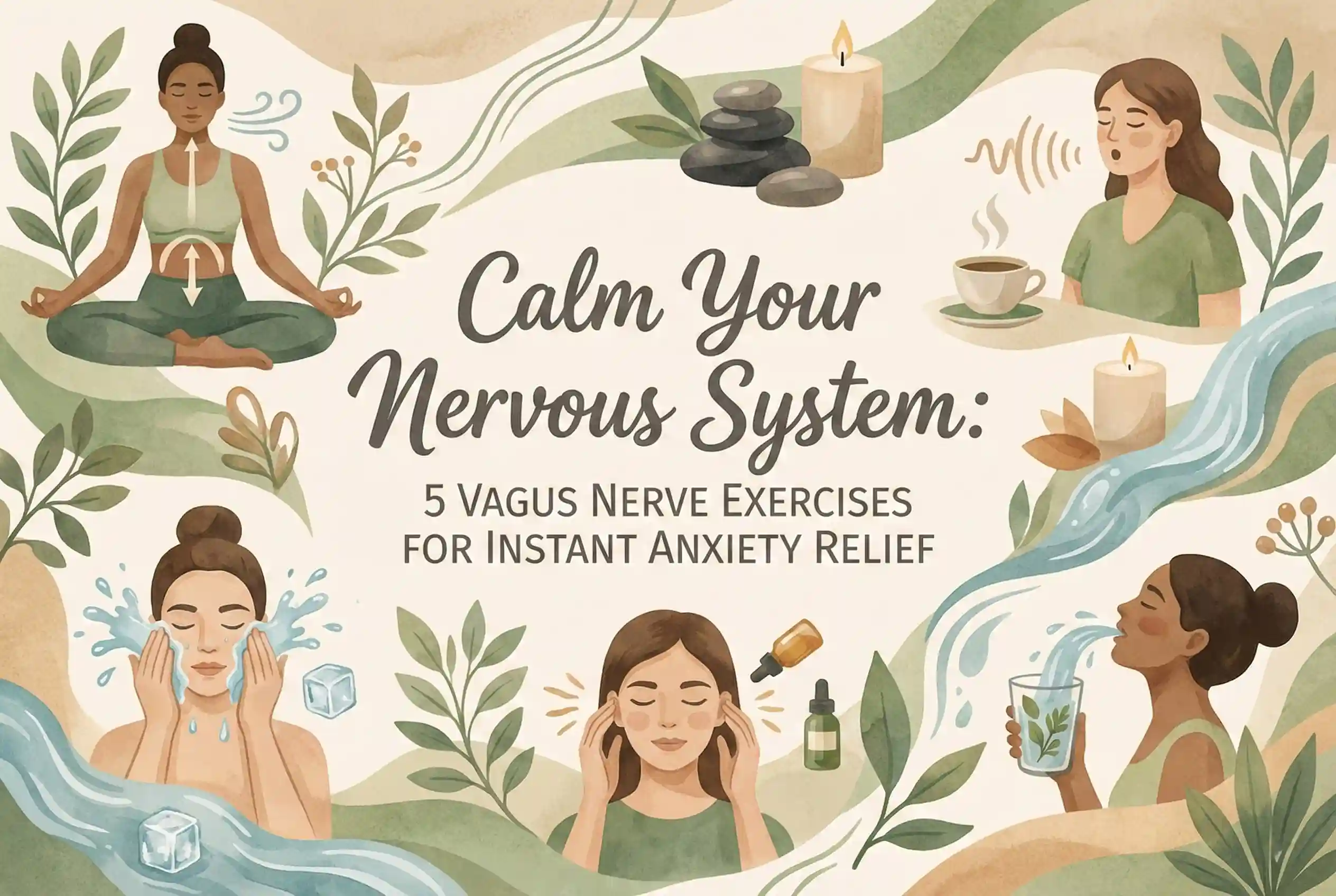
In this article, I’m sharing five exercises I regularly recommend in clinical practice, along with the science behind why they work and how to actually use them. These won’t magically cure anxiety (nothing will), but they can genuinely help you regain a sense of control when your nervous system is running the show.
What Is the Vagus Nerve (And Why Should You Care)?
Think of your vagus nerve as the main communication highway between your brain and your body. It’s the longest cranial nerve you have, wandering from your brainstem down through your neck, chest, and into your abdomen (vagus actually means “wandering” in Latin).
Here’s why it matters for anxiety: your vagus nerve is a key player in your parasympathetic nervous system, the part responsible for that “rest and digest” state. When it’s functioning well, it helps you feel calm, safe, and able to handle whatever comes your way.
The problem is, modern life keeps most of us stuck in sympathetic overdrive (the “fight or flight” response). Deadlines, traffic, emails, relationship stress, financial pressure, poor sleep. Your nervous system interprets these as threats, even when you’re not actually being chased by a predator.
The Clinical Reality: Most people I work with don’t realise they can actively influence their nervous system response. They think anxiety is just something that happens to them. But you can actually signal safety to your body through specific actions that stimulate vagal tone.
This concept comes from polyvagal theory, developed by Stephen Porges. Without getting too technical, the idea is that your vagus nerve acts like a brake on your stress response. Strong vagal tone means better braking capacity. Poor vagal tone means you’re more likely to get stuck in anxiety and have trouble calming down.
The exercises below work by directly or indirectly stimulating your vagus nerve, helping activate that parasympathetic “brake” when you need it most.
The 5 Exercises That Actually Work
1. Deep Belly Breathing (The Foundation)
This is where I start with almost every client struggling with anxiety and stress. It sounds almost too simple to work, but the physiology is solid.
How to do it:
- Sit or lie down somewhere comfortable
- Place one hand on your chest, one on your belly
- Breathe in slowly through your nose for a count of 4, letting your belly rise (your chest should barely move)
- Hold for a count of 7
- Exhale slowly through your mouth for a count of 8
- Repeat for 3-5 minutes
Why it works: When you breathe deeply using your diaphragm, you’re creating direct mechanical stimulation of the vagus nerve. The slow exhale is particularly important because it activates the parasympathetic response more strongly than the inhale.
Real talk: The first time I suggest this to clients, I can see the skepticism. “Just breathe? That’s the solution?” But here’s what I’ve observed: people who practice this consistently, especially when they’re not anxious, find it actually works when panic starts building. The key is making it a habit so your nervous system knows this pattern means safety.
My tip: If counting feels distracting, just focus on making your exhale longer than your inhale. The 4-7-8 pattern is great if you like structure, but don’t get so caught up in the numbers that you create more stress.
2. Cold Water Face Plunge (The Quick Reset)
This one gets interesting reactions. Some clients love it, others think I’ve lost the plot. But the evidence for cold exposure and vagal activation is compelling, and I’ve seen it work too many times to ignore.
How to do it:
- Fill a bowl with cold water (add ice if you can handle it)
- Take a deep breath and hold it
- Plunge your face into the water for 15-30 seconds
- Come up slowly and breathe normally
- Repeat 2-3 times if needed
The science bit: This triggers something called the diving reflex, an evolutionary response that immediately activates your parasympathetic nervous system. Your heart rate slows, blood pressure drops, and your body shifts out of fight-or-flight mode. It’s one of the fastest ways to interrupt acute anxiety.
Clinical observations: Clients report this works particularly well when they feel panic building or when they’re caught in a loop of racing thoughts. The physical shock of the cold seems to break the mental pattern.
Can’t do the full face plunge? Try these alternatives:
- Hold a cold pack or ice cubes wrapped in a cloth against your face
- Run cold water over your wrists for 30-60 seconds
- Splash cold water on the back of your neck
When to skip it: If you have any cardiovascular conditions, talk to your GP before trying cold exposure techniques. The diving reflex affects heart rate and blood pressure, which is usually beneficial but needs consideration with certain health conditions.
Key Point: These exercises work best when practiced regularly, not just in crisis moments. Your nervous system learns patterns. The more you practice these when you’re relatively calm, the easier they are to access when anxiety hits.
3. Humming or Singing (The Underrated One)
This is probably my personal favourite because it’s so accessible and you can do it anywhere (well, almost anywhere). Plus, the research on vocal toning and vagal tone is genuinely interesting.
How to do it:
- Hum a tune for 2-3 minutes (any tune works)
- Sing in the shower, in the car, while cooking
- Try “Om” chanting if you’re into that sort of thing
- Even talking out loud to yourself counts
Why it works: The vagus nerve runs right through your vocal cords and throat. When you create sustained vibration in this area through humming or singing, you’re directly stimulating the nerve. The vibration also activates the muscles around your throat that are innervated by the vagus.
Studies on “Om” chanting have shown measurable increases in vagal tone and activation of the parasympathetic nervous system. But honestly, humming “Happy Birthday” or your favourite song works just as well. It’s the vibration that matters, not the specific sound.
Practical application: I hum while I’m making breakfast, driving to appointments, folding laundry. It’s become such a habit that I barely notice I’m doing it. Several clients have told me they use this technique during their commute or before stressful meetings because it doesn’t require any special setup or privacy.
The bonus: Humming also slows your breathing naturally, so you’re getting the benefits of both techniques combined.
4. Gentle Neck and Shoulder Rolls (The Tension Release)
Most people carry stress in their neck and shoulders without realising the nervous system impact. The vagus nerve runs through this area, and chronic tension here can actually interfere with its function.
How to do it:
- Sit comfortably with your spine relatively straight
- Drop your chin toward your chest, feeling a gentle stretch at the back of your neck
- Slowly roll your head to the right, bringing your ear toward your shoulder
- Roll your head back to center, then to the left
- Focus particularly on the sides of your neck where you can feel gentle stretching
- Add shoulder rolls: bring your shoulders up toward your ears, then roll them back and down
- Repeat 5-10 times, moving slowly and deliberately
The connection: Beyond direct vagal stimulation, releasing physical tension in this area helps signal safety to your nervous system. Think about it: when you’re stressed or scared, you naturally tense your shoulders and neck. By consciously releasing that tension, you’re interrupting the stress pattern.
What I notice with clients: When I ask them to check in with their neck and shoulders, most are shocked by how much tension they’re holding. They’ve become so used to it that they don’t even register it anymore. Regular practice of these movements can help you become more aware of when stress is building before it turns into full anxiety.
Combine for extra benefit: Do these movements while practicing deep belly breathing. The combination is particularly effective for chronic stress that’s become physically embedded.
Warning: Keep everything gentle. This isn’t about forcing or pushing through pain. If something hurts, ease off. The goal is release, not more tension.
5. The 5-5-5 Sensory Grounding Exercise (The Mental Circuit Breaker)
This one works a bit differently than the others. It’s less about direct vagal stimulation and more about engaging your present-moment awareness to interrupt the anxiety loop. But the effect on your nervous system is real and measurable.
How to do it:
- Name 5 things you can see (the texture of the wall, a book on the shelf, the colour of your mug)
- Name 4 things you can physically feel (your feet on the floor, the chair supporting you, the fabric of your clothes, the temperature of the air)
- Name 3 things you can hear (traffic outside, the hum of the fridge, your own breathing)
- Name 2 things you can smell (coffee, fresh air, fabric softener on your clothes)
- Name 1 thing you can taste (or imagine tasting your favourite food)
Why it works: Anxiety lives in the future (worrying about what might happen) or the past (ruminating on what went wrong). This exercise forcibly brings your attention to right now. When you engage your senses, you’re activating different neural pathways and giving your prefrontal cortex (the rational part of your brain) something to focus on besides the anxious thoughts.
The vagal connection: Shifting your attention to sensory input helps regulate your autonomic nervous system. You’re essentially telling your body, “I’m safe enough to notice these details right now. There’s no immediate threat requiring my full attention.”
Clinical experience: This technique is particularly helpful for panic attacks or when thoughts are spiraling. It gives your mind a specific task that requires presence, which naturally starts to calm the nervous system response.
Make it your own: The specific numbers aren’t magic. Some people prefer 5-4-3-2-1, others just cycle through their senses without counting. What matters is the process of deliberately engaging with your immediate environment.
How to Actually Use These (The Practical Bit)
Having these techniques is one thing. Using them effectively is another. Here’s what I’ve learned from working with clients over the years:
Start small. Don’t try to master all five exercises at once. Pick one or two that resonate with you and practice those consistently for a couple of weeks before adding more.
Practice when you’re calm. This is crucial. If the first time you try deep breathing is during a panic attack, it’s going to be much harder. Your nervous system needs to learn these patterns when you’re relatively relaxed so they’re accessible when you’re not.
Keep notes on what works for you. Everyone’s different. Cold water might be your go-to technique while humming does nothing for you, or vice versa. Pay attention to which exercises actually shift how you feel and lean into those.
Combine exercises when needed:
- Breathing + humming creates a powerful double effect
- Cold water + grounding can interrupt severe panic
- Neck rolls + breathing addresses both physical and autonomic tension
Build them into your routine:
- Morning: gentle neck rolls and breathing before you even check your phone
- Midday: humming while making lunch or during your commute
- Evening: breathing practice before bed to improve sleep
- As needed: cold water and grounding for acute anxiety
Set reminders. Seriously. Put alerts in your phone to practice. Otherwise, these techniques stay theoretical instead of becoming actual tools you can use.
Reality Check: These exercises are genuinely helpful, but they’re not magic. If you’re practicing consistently and still struggling, or if anxiety is significantly interfering with your daily life, that’s your cue to get more comprehensive support.
When These Exercises Aren’t Enough
I need to be honest with you. Vagus nerve exercises are powerful tools, but they’re not a complete solution for everyone.
Signs you might need more help:
- You’re practicing these exercises regularly but seeing minimal benefit
- Anxiety is interfering with your work, relationships, or daily activities
- Physical symptoms are worsening (digestive issues, sleep problems, muscle tension)
- You’re relying on alcohol, food, or other coping mechanisms that aren’t serving you
- The exercises work temporarily but anxiety returns stronger
This is where comprehensive stress and mental health support becomes important. In clinical practice, I find that anxiety often has deeper physiological drivers that nervous system exercises alone can’t address:
Nutrient deficiencies: Magnesium, B vitamins, omega-3s, and vitamin D all play crucial roles in nervous system function. When these are depleted (which is common with chronic stress), your body simply can’t regulate properly.
Blood sugar dysregulation: The anxiety-inducing blood sugar roller coaster is real. Many clients don’t realise their afternoon anxiety is directly linked to what they ate (or didn’t eat) for lunch.
Hormonal factors: Thyroid dysfunction, oestrogen dominance, and cortisol dysregulation can all manifest as anxiety. If you’re a woman experiencing mood changes with your cycle, this is worth investigating.
Gut-brain axis disruption: Your gut produces most of your serotonin and is in constant communication with your brain via (you guessed it) the vagus nerve. Gut issues and anxiety often go hand in hand.
Chronic inflammation: Systemic inflammation affects brain function and can contribute to both anxiety and depression.
This is why I often recommend functional testing for clients whose anxiety isn’t responding well to standard approaches. Sometimes you need to understand what’s actually happening at a physiological level before you can address it effectively.
My approach combines these nervous system regulation tools with investigating and addressing the underlying drivers. Vagus nerve exercises help you manage symptoms while we work on the root causes. Both matter.
Final Thoughts
Let’s recap what we’ve covered:
Five accessible vagus nerve exercises:
- Deep belly breathing for foundational nervous system regulation
- Cold water face plunge for quick anxiety interruption
- Humming or singing for sustained vagal stimulation
- Gentle neck and shoulder rolls for releasing physical tension
- Sensory grounding for breaking the mental anxiety loop
Why they work: These techniques directly or indirectly activate your parasympathetic nervous system, helping shift you out of “fight or flight” and into “rest and digest.”
How to use them: Practice when calm, start with one or two techniques, keep notes on what works for you, and build them into your daily routine.
Building nervous system resilience takes practice and patience. You’re essentially retraining automatic responses that have been running for years or decades. Some days these exercises will work brilliantly. Other days you’ll wonder if you’re doing them wrong (you’re probably not; anxiety just has its own rhythm sometimes).
The goal isn’t to never feel anxious. Anxiety is a normal human emotion and sometimes it’s giving you important information. The goal is to have tools that help you regulate when anxiety becomes overwhelming or disproportionate to the situation.
And remember: if anxiety has physical drivers (which it often does), these exercises are part of the picture but not the whole solution. There’s no shame in needing more comprehensive support to work out what’s actually going on beneath the surface.
If you need support beyond these tools, book a consultation and we can work together to understand what’s driving your anxiety and build a practical plan that addresses both symptoms and root causes.
FAQ
How often should I practice vagus nerve exercises?
Daily practice is ideal, even if just for 5-10 minutes. The nervous system responds to consistency. I recommend practicing at least one technique every day when you’re relatively calm, so it becomes automatic when you actually need it. For acute anxiety, you can use these exercises multiple times throughout the day as needed.
Can vagus nerve exercises help with chronic stress or just acute anxiety?
Both. For acute anxiety or panic, techniques like cold water and sensory grounding can provide immediate relief. For chronic stress, regular daily practice of breathing, humming, and gentle movement helps build overall vagal tone and resilience over time. Think of acute exercises as crisis management and daily practice as prevention.
Are there any risks or contraindications?
These exercises are generally safe for most people. The main caution is with cold water techniques if you have cardiovascular conditions, as the diving reflex affects heart rate and blood pressure. Always check with your GP if you have any heart concerns. For the other exercises, the biggest “risk” is getting frustrated if they don’t work immediately. Be patient with yourself.
How long does it take to notice a difference?
This varies significantly between people and techniques. Some exercises (cold water, sensory grounding) can provide immediate relief during acute anxiety. For building overall nervous system resilience through daily practice, most clients report noticing changes within 2-4 weeks of consistent use. You might sleep better, recover from stress faster, or find that anxiety doesn’t escalate as quickly.
Can I do these exercises if I’m on anxiety medication?
Yes, these exercises are complementary to medication, not conflicting. Many clients use both: medication to manage baseline symptoms while building nervous system regulation skills for long-term resilience. Never stop or change medication without consulting your prescribing doctor, but these techniques can be practiced alongside pharmaceutical support. Some clients eventually work with their doctor to reduce medication as their nervous system regulation improves, but that’s a decision to make with medical supervision.