
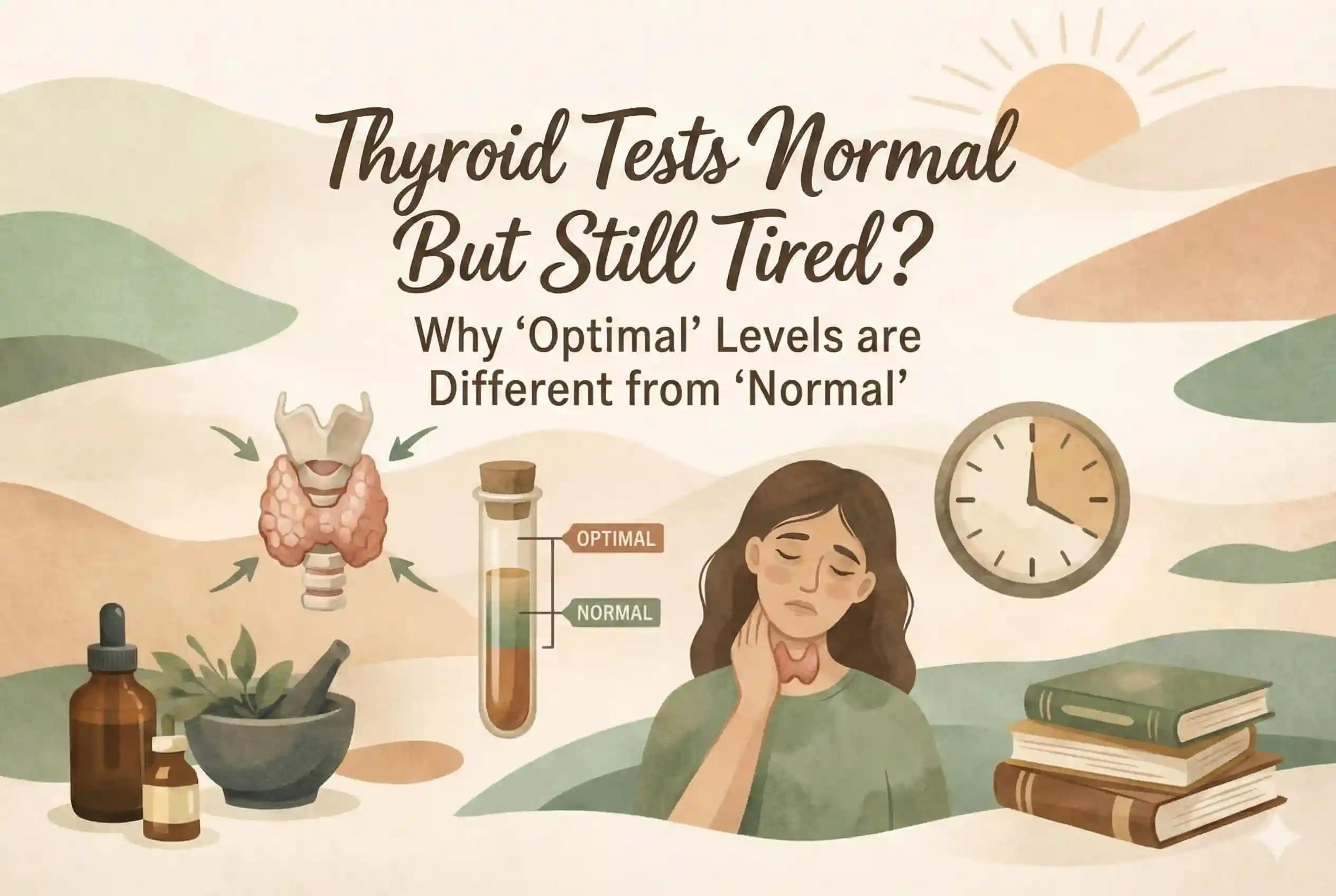
You’ve dragged yourself to the GP, again. You’re exhausted despite sleeping eight hours. Your hair’s thinning, your hands are always cold, and the weight just won’t budge no matter what you try. You explain all of this, get the blood test, wait anxiously for results, and then… “Your thyroid’s fine. Everything’s within normal range.”
But here’s the thing: you don’t feel fine. Not even close.
I see this scenario play out constantly in my practice. Just last month, a client came to me after her third round of being told her thyroid was “normal.” She was sleeping nine hours a night and still needed an afternoon nap. Her brain fog was so bad she’d forgotten her own niece’s birthday. And she’d gained seven kilos in six months without changing anything about her diet or exercise.
Her TSH? 3.6 mIU/L. Technically within the reference range of 0.5-4.0. But nowhere near optimal for her body.
This is the disconnect I want to address today: why reference ranges aren’t personalised, what optimal really means for thyroid function, and how nervous system dysregulation complicates the entire picture in ways most people (and many doctors) don’t consider.
The Problem with “Normal” Reference Ranges
Let’s talk about how those reference ranges on your pathology report actually get created. They’re not based on optimal health or how good you could feel. They’re statistical averages drawn from the general population, including plenty of people who aren’t particularly healthy themselves.
The laboratory takes blood samples from thousands of people, throws out the extreme outliers, and uses the middle 95% to create the “normal” range. That means if you’re in the bottom 5% or top 5%, you’re flagged as abnormal. But if you’re sitting at the edge of that range, feeling terrible but technically “normal”? You’re told everything’s fine.
The wide TSH range is particularly problematic. Most labs use something like 0.5-4.0 mIU/L, though I’ve seen ranges as broad as 0.4-5.0. That’s a tenfold difference between the bottom and top of the range. Someone with a TSH of 0.8 is going to feel completely different to someone at 3.8, even though both are “normal.”
I had two clients last year, both women in their early forties, both with a TSH of 3.2. One felt reasonably good and just wanted to optimise her energy for work demands. The other could barely get through the day without multiple coffees, was gaining weight despite training for a half-marathon, and had such bad brain fog she’d stopped reading books entirely because she couldn’t remember what happened chapter to chapter.
Same number. Vastly different experiences.
And here’s another critical issue: most GPs only test TSH. It’s the standard, cost-effective screening tool. But TSH is just the messenger hormone from your pituitary gland telling your thyroid to work harder or ease off. It doesn’t tell you what’s actually happening with your thyroid hormones themselves, how well you’re converting inactive T4 to active T3, or whether your immune system is attacking your thyroid tissue.
You need the full picture. Not just the knock on the door, but who’s inside the house and what they’re doing.
Key Point: “Normal” reference ranges are population averages, not individual optimal ranges. Being within range doesn’t mean your thyroid is functioning well for your specific body and circumstances.
If you’re experiencing thyroid dysfunction symptoms, it’s worth digging deeper than just TSH.
What “Optimal” Actually Means
When I talk about optimal thyroid function, I’m not referring to some arbitrary number I’ve decided is perfect. I’m talking about functional wellness, the levels at which you actually feel good, have consistent energy, maintain a healthy weight without excessive effort, and think clearly.
In my clinical experience over the past twelve years, I typically see clients feel their best when:
- TSH is between 1.0-2.0 mIU/L
- Free T3 is in the upper third of the reference range
- Free T4 is mid to upper range
- Reverse T3 is low (more on this later)
- Thyroid antibodies are absent or very low
But here’s the crucial part: optimal varies from person to person. I’ve worked with clients who feel fantastic at a TSH of 2.5, and others who need to be closer to 1.0 to feel human again. Your symptoms matter more than hitting a specific number.
This is why I always ask clients to bring copies of their actual results, not just relay that they were told everything’s “normal.” I want to see the numbers, compare them to symptoms, and track changes over time. Sometimes we see shifts that are significant for how you feel, even if they’re still within the reference range.
Your body knows what it needs. The numbers are just helping us understand the story it’s trying to tell us.
The Nervous System Connection Nobody Talks About
Right, this is where it gets interesting. And where most conventional approaches completely miss what’s happening.
Your thyroid doesn’t exist in isolation. It’s intimately connected to your nervous system through something called the HPA axis (hypothalamic-pituitary-adrenal axis). When you’re chronically stressed, anxious, burnt out, or running on adrenaline, your body shifts into survival mode.
And in survival mode, your body’s priority isn’t thriving. It’s just getting through today.
Here’s what happens: chronic stress elevates cortisol. Elevated cortisol interferes with the conversion of T4 (your inactive thyroid hormone) into T3 (the active form your cells actually use). Your thyroid might be producing perfectly adequate T4, your TSH might look fine, but if you’re not converting properly, your cells aren’t getting the message.
Even more interesting is reverse T3. Think of it as the brake pedal your body pulls when it decides you need to slow down and conserve energy. It’s a metabolically inactive form of T3 that essentially blocks the receptor sites, stopping active T3 from doing its job.
I worked with a woman last year, mid-thirties, high-achieving marketing executive. Her TSH was 1.8 (lovely), her free T4 was perfect. But her reverse T3 was through the roof, and her free T3 was sitting at the bottom of the range. She’d been working 60-hour weeks for eighteen months, her sleep was broken, and she was living on coffee and adrenaline.
Her thyroid looked “fine” on standard testing. But her body had pulled the handbrake because it was in crisis.
And it’s not just stress. Inflammation, poor sleep, blood sugar swings, gut dysfunction – all of these feed into the same cycle. Your body experiences these as threats, activates the stress response, and down-regulates thyroid function as a protective mechanism.
You can’t supplement your way out of this. You have to address the nervous system first.
If you’re dealing with chronic stress, the thyroid is just one piece of a much bigger puzzle.
Key Point: Your nervous system state directly impacts thyroid hormone conversion. Chronic stress can cause “normal” TSH but poor T4 to T3 conversion, leaving you symptomatic despite acceptable test results.
Common Symptoms That Suggest Your Thyroid Isn’t Truly Optimal
Even if your GP says your thyroid is fine, pay attention if you’re experiencing:
- Persistent fatigue despite getting adequate sleep (or needing 9+ hours just to function)
- Cold hands and feet – you’re always the one reaching for a jumper when everyone else is comfortable
- Stubborn weight gain or complete inability to lose weight despite genuinely eating well and moving your body
- Brain fog, poor concentration, memory issues – walking into rooms and forgetting why, losing your train of thought mid-sentence, struggling to retain information you’ve just read
- Hair thinning or loss, particularly from the outer third of your eyebrows (classic thyroid sign)
- Constipation that won’t budge no matter how much fibre or water you add
- Low mood, flat affect, lack of motivation – not quite depression, but you’ve lost your spark
- Dry skin, brittle nails, puffy face (especially around the eyes)
- Heavy or irregular periods, difficulty conceiving
These are your body’s signals. They’re not in your head, and they’re not just part of getting older or being busy.
If these resonate and you’re experiencing chronic fatigue, it’s worth investigating beyond standard thyroid screening.
What I Actually Test (and Why)
When someone comes to me with suspected thyroid issues, I want to see the complete picture. That means:
Full Thyroid Panel:
- TSH – the messenger hormone
- Free T4 – your inactive thyroid hormone (what your thyroid produces)
- Free T3 – your active thyroid hormone (what your cells actually use)
- Reverse T3 – the metabolic brake pedal
- Thyroid antibodies (TPO and TG) – to check for autoimmune involvement
Most GPs will order TSH, and maybe free T4 if you push. Getting the full panel often requires either a very understanding doctor or ordering tests independently.
But thyroid hormones don’t work in isolation. They need specific nutrients to function properly, which is why I often add:
Nutrient Testing:
- Iron studies (ferritin, serum iron, transferrin, saturation) – you need adequate iron for thyroid hormone production
- Vitamin D – acts as a hormone itself and supports immune function
- B12 and folate – crucial for energy production and thyroid hormone metabolism
- Zinc and selenium – essential for T4 to T3 conversion
Low ferritin is incredibly common in menstruating women and can cause thyroid-like symptoms all on its own. I’ve had clients whose “thyroid problem” was actually severe iron deficiency. Fixing the iron fixed the fatigue.
Sometimes we’ll also look at inflammation markers (CRP), blood glucose and insulin (because blood sugar dysregulation affects everything), and cortisol patterns if stress is clearly part of the picture.
I work collaboratively with GPs when possible – if your doctor is open to ordering comprehensive testing, fantastic. If not, I can organise pathology independently and we work with what we get. The goal is always to understand what’s actually happening in your body, not just tick a box.
You can learn more about my approach to functional testing here.
My Approach to Supporting Thyroid Function Naturally
Here’s what I need you to understand: you cannot supplement your way out of chronic stress. I’ll say it again for the people in the back. You cannot supplement your way out of chronic stress.
I’ve seen too many people waste money on expensive thyroid supplements while continuing to run themselves into the ground with 14-hour work days, broken sleep, and a nervous system stuck in fight-or-flight. The supplements might help a bit, but you’re trying to fill a bucket with a hole in it.
So we start with the nervous system. Always.
Practical nervous system regulation looks like:
- Teaching vagal toning techniques (specific breathing exercises, humming, cold water exposure)
- Realistic stress management that fits your actual life (not “just meditate for an hour” when you’ve got three kids and a full-time job)
- Sleep hygiene that addresses the root cause of your poor sleep, not just taking magnesium and hoping
- Movement that supports rather than further stresses your system (often less intense than you think)
Then we address the foundations:
Gut health – because 20% of thyroid hormone conversion happens in the gut, and inflammation anywhere affects thyroid function everywhere
Blood sugar balance – because insulin resistance and blood sugar swings trigger stress responses and interfere with hormone function
Inflammation – identifying and addressing sources, whether that’s food sensitivities, chronic infections, or systemic inflammation from other causes
Only then do we layer in targeted support:
Key nutrients based on your specific test results:
- Iodine (cautiously, and only when indicated – excess iodine can make autoimmune thyroid worse)
- Selenium (brilliant for conversion and reducing antibodies)
- Zinc (essential for conversion)
- Iron (if deficient)
- Vitamin D (almost everyone needs this)
- B vitamins (particularly B12 if levels are suboptimal)
Herbal support when appropriate:
- Ashwagandha or Withania for stress-related thyroid dysfunction
- Bacopa for cognitive support and thyroid function
- Rhodiola for energy and stress resilience
- Bladderwrack (only in specific circumstances and never with autoimmune thyroid)
But I don’t just throw herbs at everyone. Context matters. Your history matters. What else is going on in your body matters.
Diet plays a role too:
- Anti-inflammatory eating (whole foods, adequate omega-3s, reducing processed foods and added sugars)
- Sufficient protein (your body needs amino acids for hormone production)
- Managing goitrogens sensibly (you don’t need to avoid cruciferous vegetables entirely, cooking reduces goitrogen content and the benefits outweigh the risks for most people)
I also use herbal medicine as part of a comprehensive approach, not as a standalone solution.
This is layered, systematic work. It takes time. But it actually addresses why your thyroid isn’t functioning optimally, rather than just trying to force it to work better while the underlying problems continue.
Key Point: Supporting thyroid function naturally requires addressing nervous system dysregulation, gut health, inflammation, and nutrient deficiencies before adding targeted supplementation. There are no shortcuts.
What to Do If Your Doctor Says You’re Fine But You’re Not
First, trust yourself. If you feel terrible, something is off. Full stop.
That said, here’s how to advocate for more comprehensive testing:
Questions to ask your GP:
- “Can we test free T3 and free T4, not just TSH?”
- “Would you consider testing thyroid antibodies to rule out autoimmune involvement?”
- “Can we check my iron studies, vitamin D, and B12 at the same time?”
- “I understand I’m within range, but I’m at the higher/lower end and still very symptomatic. Can we retest in three months and track the trend?”
Frame it as wanting to be thorough and proactive about your health. Most doctors respond well to engaged patients who’ve done some research (as long as you’re not arriving with printouts from questionable internet sources).
If your GP won’t order the tests you want, that’s where I can help. I can organise pathology independently, review your results, and create a treatment plan based on what we find. Sometimes we’ll also write to your GP with our findings and recommendations so there’s coordination of care.
Even when the numbers don’t shift dramatically, tracking symptoms alongside testing is valuable. Sometimes you’ll notice significant improvements in energy, temperature regulation, or mental clarity even when TSH only moves from 3.2 to 2.8. Your experience matters.
Be patient, but also be persistent. This isn’t something that resolves in four weeks. Thyroid healing is a months-long process, sometimes longer if there’s autoimmune involvement or significant nervous system dysregulation.
And yes, sometimes thyroid medication is necessary. I’m not anti-medication. If your thyroid is genuinely underproducing and lifestyle interventions aren’t enough, medication can be life-changing. Naturopathy works beautifully alongside thyroid medication, addressing the factors that support optimal function and conversion.
Working with Me: How I Approach Thyroid Cases
If what I’ve described resonates with your experience, here’s what working together actually looks like.
Initial consultation (usually 60-75 minutes):
- Comprehensive health history going right back to childhood (patterns matter)
- Detailed symptom tracking using questionnaires and discussion
- Review of any existing test results you have
- Assessment of stress levels, sleep quality, digestive function, hormonal patterns
- Creating a clear, prioritised plan
I’m not going to promise you’ll feel amazing in six weeks. That would be dishonest. Realistic timelines for thyroid work are three to six months minimum to see meaningful, sustainable change. Some people notice improvements sooner (better sleep, less brain fog, warmer hands and feet), but full resolution takes time.
We prioritise in this order:
- Nervous system regulation and stress management
- Gut health and digestive function
- Targeted nutritional and herbal support based on your specific picture
Ongoing monitoring typically involves:
- Follow-up consultations every 4-6 weeks initially
- Retesting at 8-12 weeks to track changes
- Adjusting the plan based on how you’re responding (because everyone responds differently)
This is collaborative. I need you to tell me what’s working, what’s not, what’s realistic for your life, and what you’re struggling to implement. I’m not here to give you a perfect plan you can’t follow. I’m here to work with you to find what actually fits and gets results.
You can learn more about how I work here, and if you’re ready to get started, you can book a consultation here.
The Bottom Line
If your thyroid tests come back “normal” but you feel absolutely rubbish, something is off. Your body is not lying to you.
The reference ranges on your pathology printout are statistical averages, not individualised targets for optimal function. What matters is how you feel, how your body is functioning, and whether the life you’re living is sustainable.
Optimal thyroid function isn’t about hitting a magic number. It’s about having consistent energy throughout the day, maintaining a stable weight without excessive restriction, thinking clearly, sleeping well, and feeling like yourself.
And critically, it’s about understanding that your thyroid doesn’t exist in isolation. Your nervous system, stress levels, gut health, nutrient status, inflammation, and sleep all play into whether your thyroid can do its job effectively.
I see clients regularly who’ve been told for years that everything’s fine, who’ve started to doubt themselves, who’ve been prescribed antidepressants when what they actually needed was proper thyroid investigation and support.
You’re not making it up. You’re not being dramatic. You’re experiencing real symptoms that deserve proper investigation and treatment.
If this article has resonated with you, if you’ve been told you’re fine but you know you’re not, I’d encourage you to seek out a practitioner who’s willing to look at the whole picture. Someone who’ll test comprehensively, listen to your symptoms, and address the underlying factors rather than just managing numbers on a page.
Because optimal isn’t about being within range. It’s about feeling well, having energy for the life you want to live, and trusting that your body’s signals matter.
Sarah Mitchell is a degree-qualified naturopath (BHSc Naturopathy) and member of ATMS & ANTA, providing evidence-informed, client-centred care via online consultations throughout Australia. With over 12 years of clinical experience, Sarah specialises in thyroid health, hormone balance, and chronic fatigue, helping clients move from “normal but exhausted” to genuinely well.