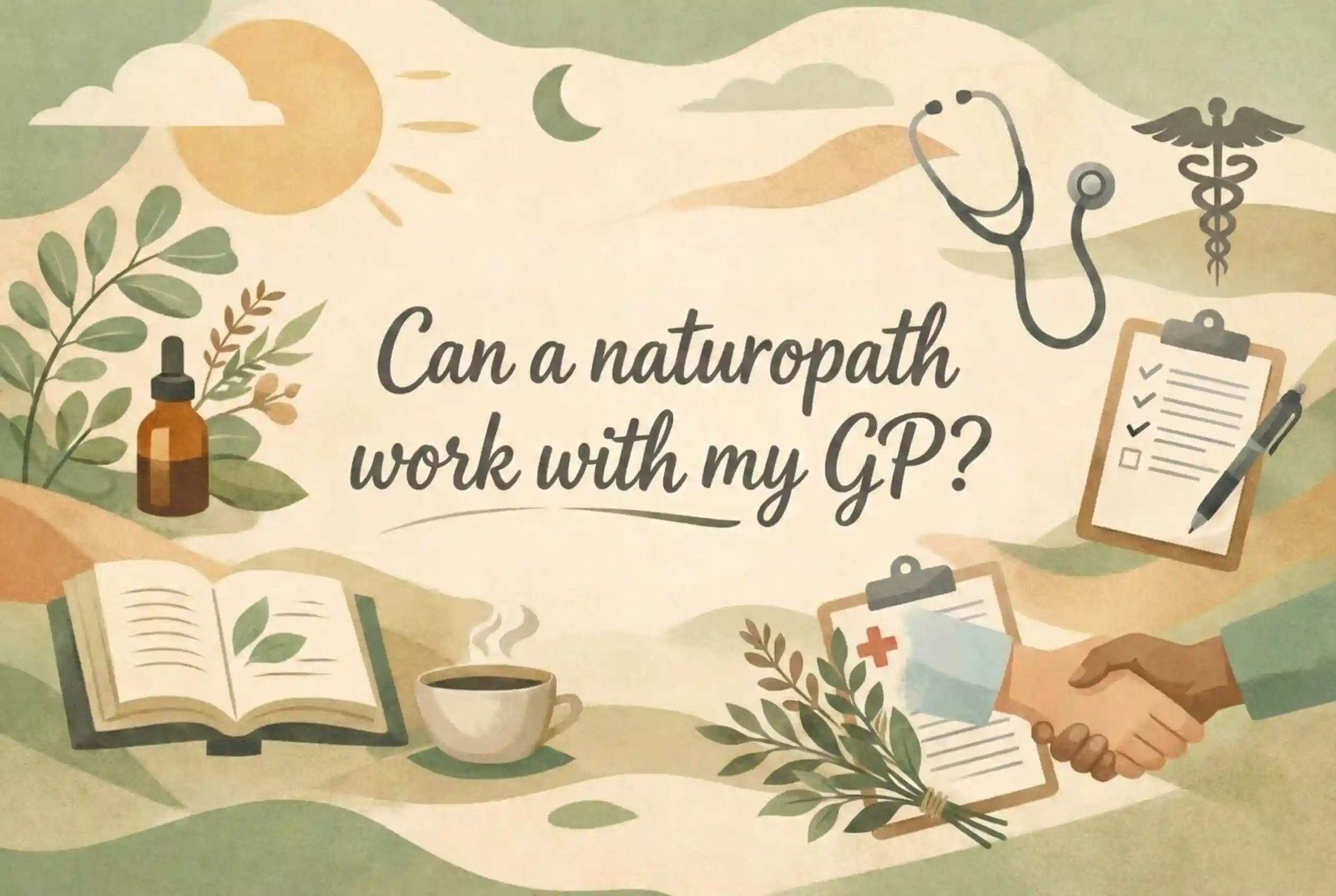
Yes, absolutely. And in my experience, it often leads to better outcomes than either approach alone.
I’ve spent 12+ years watching collaborative care produce results that neither profession could achieve independently. When a GP and naturopath work together, with the client at the center, something clicks. The medical expertise meets the lifestyle implementation. The diagnosis meets the day-to-day support. The prescription meets the nutrition protocol.
This article covers the reality of how GP-naturopath collaboration actually works, when it makes sense, and how to set it up without feeling like you’re caught between two conflicting approaches.
The Realistic Picture of Collaborative Care
Let me paint you a picture of what collaboration actually looks like.
A client comes to me already seeing their GP for hypothyroidism. She’s on levothyroxine, her TSH is stable, but she’s still exhausted, gaining weight, and struggling with brain fog. Her GP has done their job well. The medication is working. But there are gaps.
This is where I come in.
The GP handles:
- Diagnosis and monitoring of thyroid function
- Prescription of thyroid medication
- Pathology referrals for regular blood tests
- Medical oversight of the condition
I focus on:
- Optimizing nutrition to support thyroid function (selenium, zinc, iodine balance)
- Addressing gut health (many thyroid antibodies originate in the gut)
- Managing stress and sleep (both massive factors in thyroid conversion)
- Day-to-day symptom tracking between GP appointments
- Supporting liver function for hormone metabolism
Communication happens through shared test results, letters I write to her GP outlining my recommendations, and occasionally a direct phone call when needed (always with the client’s permission).
Six months later, she’s still on the same medication dose, but her energy is back, the weight is shifting, and her brain fog has cleared. The medication did its job. The nutrition and lifestyle work filled the gaps. Neither approach alone would have achieved this.
That’s collaborative care in practice.
Key Point: Collaborative care isn’t about replacing medical treatment. It’s about adding a layer of support that addresses the day-to-day implementation and the factors that medication alone can’t fix.
When Collaborative Care Works Best
I see this model work particularly well for:
Chronic conditions requiring medication plus lifestyle changes
- Type 2 diabetes (medication for blood sugar control, nutrition and lifestyle for insulin sensitivity)
- Hypertension (medication to manage immediate risk, stress management and diet for long-term improvement)
- Autoimmune conditions (medication to manage inflammation, diet and gut health to address triggers)
Mental health support
- GP prescribes antidepressants or anti-anxiety medication
- I support with nutritional psychiatry (omega-3s, B vitamins, magnesium)
- We work on sleep hygiene, stress management tools, blood sugar stability
- The medication provides the foundation, the lifestyle work builds on it
Complex digestive issues
- GP rules out serious pathology, provides symptom relief
- I order functional testing (comprehensive stool analysis, SIBO breath test)
- We identify specific triggers and rebuild gut health systematically
- What conditions can naturopathy treat? covers this in more detail
Women’s health
- PCOS: GP prescribes metformin or the pill, I support with insulin-sensitizing nutrition and stress management
- Perimenopause: GP offers HRT if appropriate, I support with phytoestrogens, adrenal care, and symptom-specific herbs
- Fertility: GP investigates medical barriers, I optimize nutrition, stress, and cycle health
The pattern is consistent. Medical treatment provides the foundation. Naturopathic support addresses the lifestyle, nutrition, and functional factors that medication can’t fix.
The Boundaries (And Why They Matter)
Let’s be crystal clear about what I don’t do, because this matters for your safety and for maintaining trust with your GP.
What I Don’t Do
I never advise stopping prescribed medication.
Never. If a client wants to reduce or stop medication, that conversation happens with their GP. I can support the process if the GP agrees, but I don’t initiate it.
I don’t diagnose medical conditions.
I can identify patterns, I can suggest functional testing, I can track symptoms. But if you need a diagnosis of diabetes, thyroid disease, or anything requiring medical treatment, that’s your GP’s role. Is a naturopath a doctor in Australia? explains this distinction clearly.
I won’t contradict medical advice without discussing concerns with both you and your GP.
If I see a potential issue (a supplement interaction, a concern about test results), I raise it with you first, then we discuss whether to contact your GP together.
What I Can Do Within My Scope
Request additional functional testing with your consent
- Comprehensive stool analysis
- SIBO breath testing
- Detailed hormone panels
- Food sensitivity testing
- These tests often provide information beyond standard pathology
Provide evidence-informed nutritional and herbal support
- Prescribe professional-grade supplements
- Create personalized meal plans
- Recommend herbs for symptom management
- All while checking for interactions with your medications
Monitor and track symptoms between GP appointments
- GPs often see you every 3-6 months
- I typically see clients every 2-4 weeks initially
- This allows for detailed tracking and adjustment of the protocol
Help you prepare for GP visits
- Organize your symptoms and questions
- Track relevant data (blood pressure, blood sugar, mood, energy)
- Provide a clear summary of what we’re working on
What can a naturopath diagnose? goes deeper into scope of practice if you’re curious.
How to Set Up Collaborative Care
This doesn’t need to be complicated. Here’s what actually works.
Before Your First Naturopathic Appointment
Bring or send through:
- Recent blood test results (last 3-6 months if you have them)
- List of current medications and supplements (including doses)
- Your GP’s main concerns or treatment goals (if they’ve discussed these with you)
- Any specialist reports if you’re seeing other practitioners
This gives me the full picture and ensures I’m not duplicating tests or recommending something that contradicts your current treatment.
What to do before seeing a naturopath has a complete preparation checklist.
Communication Between Practitioners
Here’s how this typically flows:
- Initial consultation: We discuss your current medical treatment and goals
- I create a protocol that complements what your GP is already doing
- With your permission, I write to your GP outlining my recommendations
- The letter includes:
- Summary of our consultation
- Herbal medicines and supplements I’m recommending (with doses)
- Any functional testing I’m considering
- My contact details if they have questions
You control what information is shared. Always. If you’d prefer to keep your naturopathic care separate, that’s fine too.
Most GPs appreciate a clear summary. They want to know about supplements and herbs to check for interactions. They’re relieved when someone else is handling the time-intensive nutrition and lifestyle work.
Some are more open to collaboration than others. And that’s okay.
When Your GP Isn’t Interested in Collaboration
This happens. I’m not going to pretend it doesn’t.
Some GPs are skeptical of naturopathy. Some have had bad experiences with practitioners who overstepped boundaries. Some just don’t have time or interest in integrative care.
Here’s what we do:
You become the communication bridge. I give you clear summaries of what we’re working on. You share relevant information with your GP. I focus on supporting what your GP has already prescribed rather than adding complexity.
The goal remains the same: comprehensive support for your health. It just happens through you rather than direct practitioner communication.
And honestly? This works fine for many clients. You’re in control, you coordinate the information flow, and you make the final decisions about what to implement.
Real Talk: Common Concerns
Let me address the questions I hear most often.
“Will my GP think I don’t trust them?”
In my experience, most GPs are relieved when clients take an active role in lifestyle changes.
Think about it from their perspective. They have 15 minutes with you. They can prescribe medication, order tests, provide medical advice. They cannot spend an hour creating a personalized meal plan. They cannot follow up with you every two weeks to adjust your stress management protocol. They cannot order specialized gut testing that Medicare doesn’t cover.
Many GPs refer to naturopaths themselves for exactly this reason. They recognize the value of having someone else handle the time-intensive work they simply cannot provide in standard appointments.
It’s not about replacing medical care. It’s about adding a layer of support that complements it.
“What if recommendations conflict?”
This is why clear communication matters.
Here’s an example from my practice:
A client was prescribed a blood thinner by her cardiologist. She wanted to start fish oil for inflammation. Fish oil has mild blood-thinning properties. Taken together without medical oversight, this could increase bleeding risk.
I contacted her cardiologist (with her permission), explained what we were considering, and asked for guidance. The cardiologist adjusted her blood thinner dose slightly and gave us the green light.
Your safety is always the priority. If I see a potential conflict, we pause, clarify with your GP or specialist, and proceed only when it’s safe to do so.
I’ve also flagged abnormal test results that clients thought were fine, encouraged GP follow-up for symptoms that needed medical investigation, and referred clients back to their GP when something fell outside my scope.
Collaboration means everyone stays in their lane and communicates when lanes overlap.
“My GP said naturopathy is rubbish”
I acknowledge this happens. Less often than 10 years ago, but it still does.
You have a few options:
Option 1: See both practitioners without discussing it
- You’re entitled to seek multiple opinions and approaches
- Keep your naturopathic care separate from your medical care
- Share information only when necessary (like medication and supplement lists)
Option 2: Find a GP more open to integrative care
- Many GPs now have training in integrative medicine
- Some actively encourage complementary approaches
- Ask around, check online reviews, look for GPs who mention holistic or integrative care
Option 3: Have a calm conversation with your current GP
- Explain you’re not replacing their care, just adding support
- Show them my letter outlining recommendations
- Emphasize that you value their medical expertise and want to keep them informed
Most skeptical GPs soften when they see:
- You’re still following their medical advice
- The naturopath isn’t making wild claims or dangerous recommendations
- You’re taking responsibility for the lifestyle changes they’ve been recommending for years
Does naturopathy really work? addresses the evidence base if you need information to share.
What Makes This Work Long-Term
Collaborative care isn’t just about the initial setup. Here’s what keeps it working over months and years.
Clear Roles and Realistic Expectations
Neither practitioner is trying to do the other’s job.
Your GP isn’t going to spend an hour discussing gut bacteria strains or designing an anti-inflammatory meal plan. That’s not their training or their role.
I’m not going to diagnose your thyroid condition or prescribe levothyroxine. That’s not my scope or training.
I’m not trying to replace your GP. I’m filling gaps in time, testing, and implementation support.
Your GP likely doesn’t have time for:
- Detailed meal planning based on your schedule, preferences, and health goals
- Weekly check-ins to adjust your stress management protocol
- Ordering and interpreting comprehensive stool analysis
- Troubleshooting supplement timing and dosing
That’s what I do. And I do it while respecting the medical foundation your GP has established.
You’re the Center of Your Care Team
This is crucial. You decide what information is shared. You choose which recommendations to implement. You coordinate appointments and follow-up.
This isn’t about being caught between two practitioners giving conflicting advice. It’s about having a team that supports different aspects of your health, with you making the final calls.
Some clients implement everything I suggest. Others pick and choose based on what fits their life. Both approaches are fine. You’re the one living with these changes. You’re the one who knows what’s sustainable.
This puts you in control, not caught in the middle.
The Practical Benefits I See Regularly
When collaborative care works well, here’s what happens:
Faster progress on complex conditions
- The combination of medical treatment and comprehensive lifestyle support accelerates results
- Clients often reduce medication needs over time (always under GP supervision)
- Symptoms improve more completely than with either approach alone
Better medication outcomes
- Nutrition and lifestyle changes enhance medication effectiveness
- Side effects often reduce when overall health improves
- Clients feel more in control of their health rather than dependent on medication alone
Clients feeling heard and supported between medical appointments
- GP appointments every 3-6 months leave big gaps
- Regular naturopathic follow-up provides accountability and support
- Symptoms are tracked and addressed rather than waiting for the next GP visit
More comprehensive testing when standard pathology doesn’t show the full picture
- Functional tests can identify issues before they become medical diagnoses
- Early intervention often prevents conditions from progressing
- Do naturopaths do blood tests? explains testing options in detail
When to Consider Seeing Both
Not everyone needs collaborative care. But here are situations where it often makes sense.
You’re on medication but symptoms aren’t fully resolved
The medication is working (your test results prove it), but you still don’t feel well.
This is incredibly common with thyroid conditions, diabetes, and mental health. The numbers improve, but the symptoms linger. Fatigue, weight gain, brain fog, low mood persist despite “normal” test results.
This is where naturopathy excels. We address the factors that medication can’t fix: nutrient deficiencies, gut health, stress, sleep, inflammation, blood sugar instability.
You stay on your medication. We add the lifestyle and nutritional support that fills the gaps.
Your GP has recommended lifestyle changes but you need help implementing them
“Lose weight, reduce stress, exercise more” is common advice. Actually doing it requires a detailed, personalized plan.
Your GP doesn’t have time to:
- Create a meal plan that fits your work schedule and food preferences
- Teach you specific stress management techniques and troubleshoot when they don’t work
- Design an exercise program that matches your current fitness level and energy
- Follow up every two weeks to adjust the plan based on what’s working
That’s exactly what I do in consultations. We take the general advice and turn it into specific, actionable steps you can actually implement.
You want functional testing your GP doesn’t offer
Standard pathology is excellent for diagnosing disease. It’s less helpful for identifying subclinical imbalances or functional issues.
Sometimes we need:
- Comprehensive stool analysis to identify gut infections, low digestive enzymes, or inflammation
- SIBO breath testing when bloating and IBS symptoms persist despite normal colonoscopy
- Detailed hormone panels that track more than just TSH or progesterone
- Food sensitivity testing to identify triggers for skin conditions or digestive issues
These tests aren’t always necessary. But when standard pathology is normal and symptoms persist, they often fill important gaps.
Functional testing explains what’s available and when it’s worth considering.
You’re dealing with multiple practitioners and need coordination
Specialist. GP. Mental health professional. Physiotherapist. Maybe an endocrinologist or cardiologist.
Someone needs to look at the whole picture. Someone needs to ask: How do all these treatments interact? What are we missing? What’s the underlying pattern?
Naturopathy is designed for this whole-person view. We’re trained to connect the dots between systems, to see how gut health affects mood, how stress impacts hormones, how inflammation links to pain.
If you’re seeing multiple practitioners and no one is coordinating the overall picture, that’s a gap naturopathy can fill.
Key Takeaway: Collaborative care works best when each practitioner stays in their expertise, communicates clearly, and keeps you at the center of decision-making. It’s not about one profession being better. It’s about using the strengths of each to support your health more comprehensively.
Final Thoughts
Collaborative care isn’t about one profession being better than the other.
It’s about using the strengths of each to support your health more comprehensively.
Your GP brings:
- Diagnostic skills and medical training
- Prescribing rights and access to subsidized pathology
- Medical monitoring and disease management
- Referrals to specialists when needed
I bring:
- Time to explore your health history in detail (initial consultations are 60-90 minutes)
- Detailed nutrition and lifestyle protocols tailored to your life
- Functional medicine tools and specialized testing
- Regular follow-up and accountability between medical appointments
Together, with you at the center making the final decisions, it often works better than either approach alone.
If you’re already seeing a GP and wondering whether naturopathic support could help, the first step is being open with both practitioners about what you’re looking for.
Tell your GP you’re considering naturopathic support for the lifestyle and nutrition side of your health. Ask if they’re open to receiving a letter outlining recommendations. Most will say yes.
Tell your naturopath (me, if you decide to work together) what your GP is treating and what medications you’re on. I’ll build a protocol that complements their work, not contradicts it.
You don’t need permission from either practitioner to see the other. But clear communication makes everything work better.
Ready to explore whether collaborative care makes sense for you?
If you’re already seeing a GP and wondering whether naturopathic support could help, let’s talk.
I offer a free 15-minute discovery call where we discuss:
- Your current treatment and what’s working (or not)
- Your health goals and what you’re hoping to achieve
- Whether collaborative care makes sense for your situation
- How I work with GPs and what communication looks like
Book a free discovery call and we’ll figure out if this approach is right for you.
No pressure, no sales pitch. Just an honest conversation about whether adding naturopathic support to your current care could help you feel better.
Sarah Mitchell, BHSc (Naturopathy)
Member of ATMS & ANTA
Providing evidence-informed, personalized naturopathic care Australia-wide via online consultations