
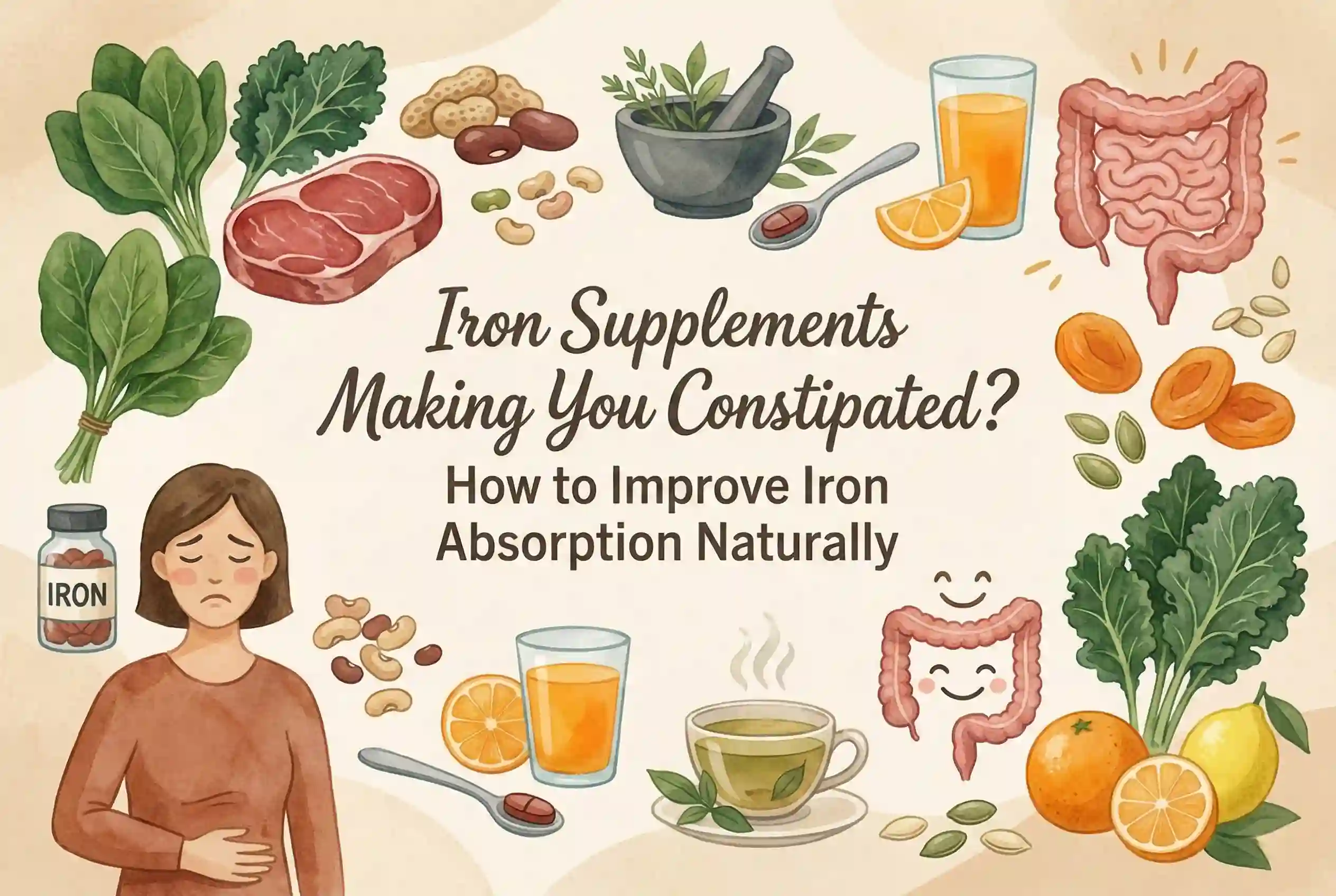
You finally got your iron levels tested. The results came back low, your GP handed you a script for iron supplements, and you left feeling hopeful that your energy might actually improve.
Fast forward two weeks: you’re constipated, uncomfortable, and honestly wondering if the cure is worse than the problem. You’re not alone. This is one of the most common frustrations I hear from clients, and it’s entirely fixable.
I’m Sarah Mitchell, a degree-qualified naturopath who’s spent over 12 years helping people navigate exactly this kind of situation. The good news? You don’t have to choose between fixing your iron levels and having functional digestion. Let me show you what actually works.
Why Iron Supplements Cause Constipation (The Science Made Simple)
Here’s what’s happening: when you swallow an iron tablet, it passes through your digestive system and not all of it gets absorbed. The unabsorbed iron sits in your gut, and this is where the trouble starts.
Iron has an oxidative effect on your gut lining. Think of it like rust forming on metal, except it’s happening inside your intestines. This irritation slows down gut motility (the movement that keeps things, well, moving), and it also draws water out of your stool, making it harder and more difficult to pass.
The form of iron matters enormously. Ferrous sulfate, the most commonly prescribed form, is cheap and widely available, but it’s also the biggest culprit for digestive upset. It’s poorly absorbed, meaning more unabsorbed iron hanging around causing problems.
The dosage is another factor. Many standard prescriptions start at 100mg or more of elemental iron daily. For someone with a sensitive digestive system, this can feel like a sledgehammer when you needed a gentle tap. More iron doesn’t always mean better absorption, it often just means more side effects.
If you’re already dealing with digestive issues, iron supplementation can make things significantly worse. I often work with clients on digestive health concerns, and iron is frequently the thing that tips them over the edge from manageable symptoms to genuine discomfort.
The Forms That Tend to Be Gentler (What I Recommend to Clients)
Not all iron supplements are created equal, and switching forms can make a massive difference.
Iron bisglycinate (also called iron glycinate) is my go-to recommendation for clients who’ve struggled with standard iron. It’s a chelated form, meaning the iron is bound to the amino acid glycine. This makes it easier to absorb and significantly gentler on the gut. Studies consistently show better tolerance and fewer digestive side effects compared to ferrous sulfate.
Iron polysaccharide complex is another option. It’s less common but can work well for people who don’t tolerate bisglycinate.
Liquid iron formulations can sometimes be easier on the system, particularly if you’re dealing with nausea alongside constipation. They also allow for more precise dosing, which means you can start really low and gradually increase.
Here’s the reality check: even the gentlest forms can still cause issues for some people. Iron is inherently constipating. But the difference between tolerating a supplement and abandoning it altogether often comes down to choosing the right form and dose for your body.
### Key Points: Choosing a Gentler Iron Supplement – **Iron bisglycinate is generally the best tolerated form** for most people – Liquid formulations allow for easier dose adjustment – Start with a lower dose than recommended and increase gradually – Even “gentle” iron can cause constipation in sensitive individuals – Quality matters: look for practitioner-grade supplements where possible
Timing and Pairing Strategies That Actually Work
You’ve probably heard that iron should be taken on an empty stomach for maximum absorption. Technically true, but if taking it on an empty stomach leaves you nauseous and constipated, what’s the point?
Here’s what I tell clients: take your iron with a small amount of food if you need to. Yes, absorption might be slightly reduced, but you’ll actually take it consistently, which matters far more than theoretical perfect absorption that you can’t sustain.
The vitamin C pairing is often touted as essential. Vitamin C does enhance non-heme iron absorption, so having some citrus, capsicum, or berries with your supplement can help. But it’s not magic, and it won’t override a form of iron that doesn’t suit you.
What to avoid around iron supplementation:
- Calcium-rich foods or supplements (dairy, fortified plant milks, calcium tablets) can inhibit iron absorption. Space them at least two hours apart.
- Tea and coffee contain tannins that bind to iron. If you’re a committed coffee drinker, have your iron well away from your morning brew.
- High-fibre meals taken simultaneously can reduce absorption. This doesn’t mean avoid fibre (you need it for the constipation), just don’t have your iron with a massive bowl of bran.
Should you take your full dose once daily or split it? For constipation management, splitting your dose (if you’re on a higher amount) can reduce the gut load at any one time. A smaller dose twice daily often causes fewer digestive issues than a large single dose.
Food-Based Iron: Is It Enough?
This is the question everyone wants answered: can I just eat more iron-rich foods and skip the supplements?
Sometimes yes, often no. It depends entirely on how deficient you are, what’s causing the deficiency, and your ability to absorb dietary iron.
Heme iron comes from animal sources (red meat, poultry, fish). It’s significantly better absorbed than non-heme iron, which comes from plant sources (spinach, lentils, tofu, fortified cereals). Your body absorbs about 15-35% of heme iron compared to only 2-20% of non-heme iron.
If you’re vegetarian or vegan, you’re working harder to get adequate iron. It’s possible, but it requires consistent attention to combining iron-rich foods with vitamin C sources and avoiding absorption inhibitors.
Best food sources of iron:
- Red meat (beef, lamb)
- Organ meats (liver, kidney)
- Shellfish (oysters, mussels)
- Sardines
- Chicken and turkey (dark meat)
- Lentils, chickpeas, beans
- Tofu and tempeh
- Pumpkin seeds, hemp seeds
- Quinoa
- Dark leafy greens (though absorption is lower)
The reality: if your iron levels are genuinely low (ferritin under 30, for example), food alone will take a very long time to correct this. I work with clients using a nutrition and dietary approach as part of their overall plan, but when iron is severely depleted, supplementation is usually necessary to get levels up within a reasonable timeframe.
Once your levels are replete, maintaining them with food is absolutely achievable for most people.
Supporting Your Digestive System While Taking Iron
If you’re going to take iron supplements, you need to actively support your digestive system. Constipation isn’t inevitable, but you have to work with your body, not against it.
Magnesium is your friend here. It draws water into the bowel and relaxes the muscles of the digestive tract. Many people are low in magnesium anyway, so supplementing serves double duty. I often recommend magnesium citrate or magnesium glycinate in the evening. Start with 200-300mg and adjust based on bowel response.
Hydration matters more than you think. When you’re constipated, your instinct might be to drink more water. Good instinct. But if you’re taking iron and not drinking adequately, you’re making the problem worse. Aim for at least 2 litres of water daily, more if you’re active or it’s warm.
Fibre is essential, but there’s a balance. You need enough fibre to keep things moving, but if you suddenly increase fibre dramatically while taking iron, you might feel more bloated and uncomfortable. Gradual increases work better. Focus on:
- Vegetables (especially cooked vegetables if raw ones bloat you)
- Fruit (particularly kiwifruit, which has been shown to improve bowel regularity)
- Chia seeds, ground flaxseeds
- Psyllium husk (start low, increase slowly)
Movement matters. Sitting all day slows everything down, including your bowels. Even a 15-minute walk daily can make a difference. I’ve had clients report that their constipation improved significantly just from adding regular movement, even without changing their iron dose.
What about probiotics? There’s emerging evidence that certain probiotic strains might help with constipation, particularly Bifidobacterium and Lactobacillus species. They won’t fix iron-induced constipation on their own, but as part of a broader approach, they can be helpful. If you’re dealing with gut issues beyond constipation, a targeted probiotic might be worth considering.
### Key Points: Managing Constipation While Taking Iron – **Add magnesium supplementation** (200-300mg daily, adjust as needed) – **Stay well hydrated** (minimum 2 litres water daily) – **Increase fibre gradually**, focusing on vegetables, fruit, and seeds – **Move your body daily**, even just a short walk – **Consider a targeted probiotic** if constipation persists – **Don’t rely on stimulant laxatives** as your long-term solution
When It’s Time to Investigate Further
Sometimes constipation from iron supplementation points to a bigger picture problem. If you’ve tried gentler forms, adjusted your dose, supported your digestion, and you’re still struggling, it’s worth digging deeper.
Signs your iron issue might be absorption-related:
- You’ve been supplementing for months but your levels aren’t improving
- You’re taking a reasonable dose but experiencing severe side effects
- You have other unexplained digestive symptoms (chronic diarrhoea, bloating, reflux)
- You have a family history of coeliac disease or inflammatory bowel conditions
Conditions that affect iron absorption include coeliac disease, Crohn’s disease, ulcerative colitis, H. pylori infection, and low stomach acid (hypochlorhydria). If you’re taking iron faithfully but your ferritin isn’t budging, absorption is likely the issue, not intake.
Testing matters. A standard full blood count will show you if you’re anaemic, but it won’t give you the full picture. Ferritin (your iron stores) is the more useful marker for understanding iron status. I also look at transferrin saturation, serum iron, and sometimes total iron-binding capacity to get a complete view.
“Normal” lab ranges are broad. A ferritin of 15 is technically within normal range, but you’ll likely feel exhausted and foggy. Optimal is different from normal. I generally aim for ferritin levels of at least 50-70 for most clients, higher if they’re very active or have specific health conditions.
If absorption is genuinely impaired, functional testing can help identify why. Comprehensive stool testing, coeliac screening, or assessment for small intestinal bacterial overgrowth (SIBO) might be relevant depending on your symptoms.
Alternative Delivery Methods Worth Considering
Sometimes oral iron just doesn’t work, no matter how many adjustments you make. That’s when alternative delivery methods become relevant.
Iron infusions are increasingly common and can be genuinely life-changing for people who can’t tolerate oral iron or whose levels won’t respond to it. You get a high dose of intravenous iron, your levels come up quickly, and you skip the digestive side effects entirely. The downsides are cost (usually a few hundred dollars even with private health insurance) and the need for a GP referral and medical supervision.
Intramuscular injections are another option, though less commonly used. They’re generally reserved for people with severe absorption issues or those who’ve failed oral supplementation.
Transdermal or topical iron products are available, and some clients are curious about them. The evidence for effectiveness is limited, and absorption through the skin is far less efficient than oral or intravenous routes. I don’t routinely recommend them, but for someone who absolutely cannot tolerate any other form and has mild deficiency, they might be worth trying.
The reality is that oral supplementation works for most people when the form, dose, and supportive strategies are right. But knowing alternatives exist can be reassuring if you’re genuinely struggling.
My Practical Protocol for Clients (Real-World Application)
When I work with someone who’s dealing with low iron and constipation, here’s the approach I take:
Start low, go slow. Even if your GP has prescribed 100mg daily, if you’re constipated and miserable, we scale back. I often start clients on 24-30mg of elemental iron (using bisglycinate) and increase gradually as tolerance allows. Slower improvement is better than no improvement because you couldn’t stick with it.
Monitor and adjust. We retest ferritin every 8-12 weeks initially to see how you’re responding. If levels are rising, we know the dose is working. If not, we investigate further or adjust the approach.
Set realistic expectations. Iron repletion takes time. You might start feeling better within a few weeks, but it can take 3-6 months to properly restore depleted iron stores. This isn’t a quick fix, and that’s okay.
Balance symptom management with iron goals. If you’re so constipated you’re avoiding the supplement, we need to fix the constipation first. Magnesium, hydration, fibre, movement, and potentially a very gentle natural laxative (like prunes or kiwifruit) become priorities alongside the iron.
Retest and reassess. Once your levels are optimal, we look at whether you need ongoing supplementation or whether dietary intake can maintain your levels. Some people need long-term low-dose supplementation (particularly if they have heavy periods or are vegan), others can maintain with food alone.
This is exactly the kind of individualised approach I use with clients in my online consultations. Everyone’s situation is different, and cookie-cutter protocols rarely work when you’re dealing with something as individual as iron status and digestive function.
What to Do If You’re Already Constipated
You’re reading this because you’re already uncomfortable. Here’s what to do right now:
Reduce your iron dose temporarily. If you’re taking 100mg daily and you haven’t had a bowel movement in three days, drop to 30mg or even take a day or two off entirely. Your iron levels won’t plummet overnight, but your quality of life matters.
Increase magnesium immediately. Start with 300-400mg of magnesium citrate in the evening. If you don’t get relief within 24 hours, you can increase slightly, but go gradually to avoid diarrhoea.
Hydrate aggressively. Two litres minimum, spread throughout the day. Warm water or herbal tea can be soothing and might help stimulate movement.
Natural stool softeners that work:
- Prunes or prune juice (genuinely effective, not just an old wives’ tale)
- Kiwifruit (two daily has been shown to improve bowel regularity)
- Ground flaxseeds (1-2 tablespoons in water or smoothies)
- Psyllium husk (start with half a teaspoon, increase gradually, must be taken with plenty of water)
- Aloe vera juice (small amounts, not the laxative formulas)
Avoid harsh stimulant laxatives like senna unless absolutely necessary. They can cause cramping and dependency if used regularly. If you’re at the point where you need a laxative, use something gentle like lactulose or macrogol (available from pharmacies).
Move. Even if it’s just walking around the block, movement helps. Gentle abdominal massage in a clockwise direction can also stimulate bowel activity.
Once you’ve got some relief, go back to your iron at a lower dose and build up your digestive support strategies so this doesn’t keep happening.
Final Thoughts: It Doesn’t Have to Be This Hard
Low iron is incredibly common, especially in women of reproductive age, athletes, vegans, and people with digestive conditions. It’s also incredibly fixable, but not at the expense of your digestive comfort and quality of life.
If you’ve been told to just push through the constipation, or that it’s a normal side effect you have to accept, I’m here to tell you that’s not true. There are gentler forms, better dosing strategies, and supportive measures that make iron supplementation manageable for the vast majority of people.
The key is finding an approach that works for your body, not forcing your body to accept an approach that doesn’t suit you.
If you’re struggling with low iron, constipation, or both, you don’t have to figure this out alone. I work with clients Australia-wide via online consultations, providing personalised support that takes your whole situation into account, not just your iron levels.
We’ll look at the right form and dose of iron for you, address any underlying absorption issues, support your digestion properly, and monitor your progress with appropriate testing. No more guessing, no more suffering through side effects, just a clear plan that actually works.
Ready to Sort Out Your Iron Levels Without the Digestive Drama?
If you’re tired of choosing between energy and comfortable digestion, book a consultation and let’s create a plan that works for you. I offer online appointments that fit your schedule, wherever you are in Australia.
Not sure if working together is the right fit? Check out how I work with clients or get in touch through my contact page with any questions.
You deserve to feel well, and you definitely don’t deserve to be constipated in the process.
Sarah Mitchell, BHSc (Naturopathy)
Member of ATMS & ANTA
Providing evidence-informed, personalised naturopathic care Australia-wide